
It all started with something I noticed at the end of last week… an unusual kind of fatigue seemed to be getting to me… a bit strange to say 😅
But above all, this fatigue felt like déjà vu. Let me explain:
When I spend day after day producing code, morning & afternoon, with no real break, because the project interests me and I'm therefore highly motivated…
At the start of 2026, after almost two decades, I felt I had done everything there was to do in my job… and then a project where I used AI let me have a blast again. AI became a major help in putting my creativity into practice: bug fixing is greatly reduced, and I feel I can add any technical feature with ease (without spending hours in documentation as before). In short, it was fun.
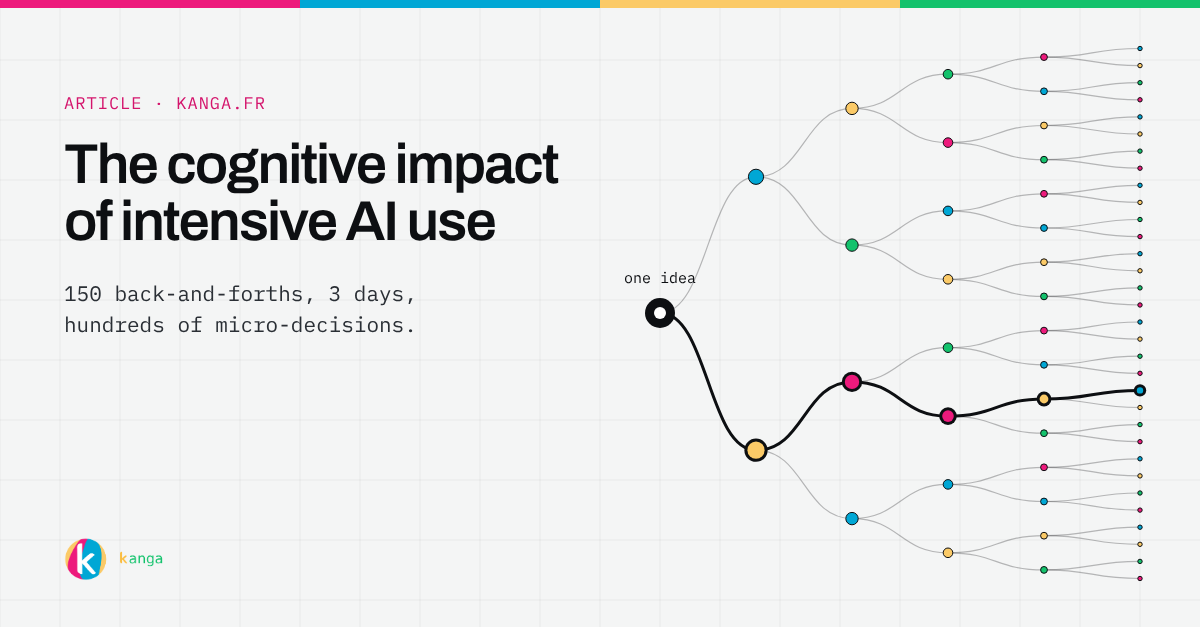
But this time, the phenomenon felt different. It happened while building the ludovisio.fr website and thinking through how to position the offer: more than 150 back-and-forths with AI, all in less than 3 days.
I had an idea, I laid it down, steered the AI, generated, told myself it wasn't what I was looking for, thought again, changed the prompts… Day after day my brain was buzzing, and I reached a result beyond what I had initially imagined.
For months, even years, I have paid close attention to the mental and cognitive fatigue that comes with this kind of task. After 2 weeks of a fatigue I struggled to understand, my intuition was that cognitive over-stimulation was behind it…
And indeed, digging into the question, studies are starting to appear: decision fatigue, cognitive overload, the disappearance of the small tasks that used to serve as mental breaks…
In August 2026, a study published in the Journal of Enterprise Information Management looked at “decision fatigue and cognitive overload” related to generative AI. The researchers surveyed 460 knowledge workers. They found that certain constraints linked to intensive use of generative AI — task complexity, time pressure, the need to check answers/hallucinations, etc. — are associated with both cognitive overload and decision fatigue.
https://doi.org/10.1108/JEIM-10-2025-1027
With each iteration, the person is no longer just typing text but going through the following sequence:
idea → request → reading → evaluation → choice → correction → new possibility → decision → test → new idea…
Another study, published in Frontiers in Artificial Intelligence at the end of 2025, interviewed professionals working mainly in IT and R&D. They describe a phenomenon of techno-overload: AI speeds up work, which makes some small, simple tasks disappear, tasks that used to act as mental breaks. Work increasingly consists of complex, conceptual tasks.
The participants describe something even closer to what I felt: since AI makes it possible to move much faster, one person can handle many more topics at the same time, especially when their role shifts from “doing” to “supervising / checking”. The authors link this to a possible increase in work intensity and cognitive overload.
https://www.frontiersin.org/journals/artificial-intelligence/articles/10.3389/frai.2025.1728881/full
A CHI 2025 study covering 319 knowledge workers and 936 real-life uses of generative AI shows that AI generally reduces the perceived effort of producing an answer, but shifts the intellectual effort. We move more:
- from searching for information → to checking that information
- from solving the problem → to integrating the AI's suggestions
- from execution → to supervision or steering
In other words, the brain works differently: less raw production, more constant judgement.
https://dl.acm.org/doi/10.1145/3706598.3713778
AI does part of the production, but the human remains in charge of every branching point, and that is where things go wrong:
- My back-and-forths with AI saved me a huge amount of coding time, but at the cost of hundreds of micro-decisions.
- Where I thought AI + same amount of work = less load, what I mostly got was: AI = multiplied capacity > multiplied ambitions > multiplied experiments… and therefore overload.
I think it is important to learn to artificially reintroduce the limits that technology has just removed. I'm going to keep thinking about it.
What do you think? Have you ever experienced this kind of situation?